
Person Meta_Codes

Overview The Person Meta Codes view provides a governed and curated attribute layer for the Person domain, representing identity, linkage, restricted classification, and limited mirrored assignment context for each canonical PERSON_UID. This view extends person.core_details by introducing structured attributes using the CDM meta pattern, enabling controlled person-based reporting and cross-system identity linkage. It is designed … Read more
Util.Identity_PersonID

Overview util.identity_personid provides a resolved and reusable identity mapping between source-system person records and a canonical PERSON_UID. It supports the Person domain by combining: into a single trusted identity layer. This process reduces duplication, improves cross-system linking, and provides a stable foundation for: Purpose How It Works 1. Extract Source Email Identities Source: Processing: Outcome: … Read more

Person Core_Details

Overview The Person Core Details view defines the canonical person object for the IFS and external app-aligned Person domain within the Common Data Model (CDM). It provides a controlled identity layer for representing a human individual independently of any single employment record, using a stable PERSON_UID and a small set of governed link attributes. This … Read more

Employee Meta Dates

Overview The Employee Meta Dates view provides a structured temporal layer for employee objects within the Common Data Model (CDM). It captures key lifecycle dates associated with employees and presents them in a standardised attribute format, aligned to the CDM meta pattern. This view complements: Purpose Key Features 1. Structured Date Model Each date is … Read more

Employee Meta Codes

Overview The Employee Meta Codes view provides a structured, extensible attribute layer for employee objects within the Common Data Model (CDM). It transforms employee-related attributes into a standardised code-based format, enabling consistent classification, filtering, and reporting across all employee-driven use cases. This view extends employee.core_details by introducing contextual attributes grouped by domain, without compromising the … Read more

Employee Core Details

Overview The Employee Core Details view defines the canonical employee object within the Common Data Model (CDM). It establishes a stable and consistent representation of each employee by combining identity, descriptive attributes, and system linkages into a single, governed structure. This view forms the foundation for all employee-related domains, enabling consistent joins, secure identity handling, … Read more

Release 94

Summary of Impact πŸ”§ Project Domain Enhancements Project Meta Codes – Roles Project Meta Codes (Core View) Project Manager Attribute – Reinstated Project Item Codes (UKS) πŸ‘€ Person Domain (New) Core Views Person Meta Codes 🧾 Invoice Domain Update Invoice Meta Codes πŸ“Š Business Opportunities (APC) busopp_details_plus_APC πŸ’° Finance Domain Expansion Accounts Receivable – Item … Read more

Condensed META_TYPE Taxonomy for Analysts

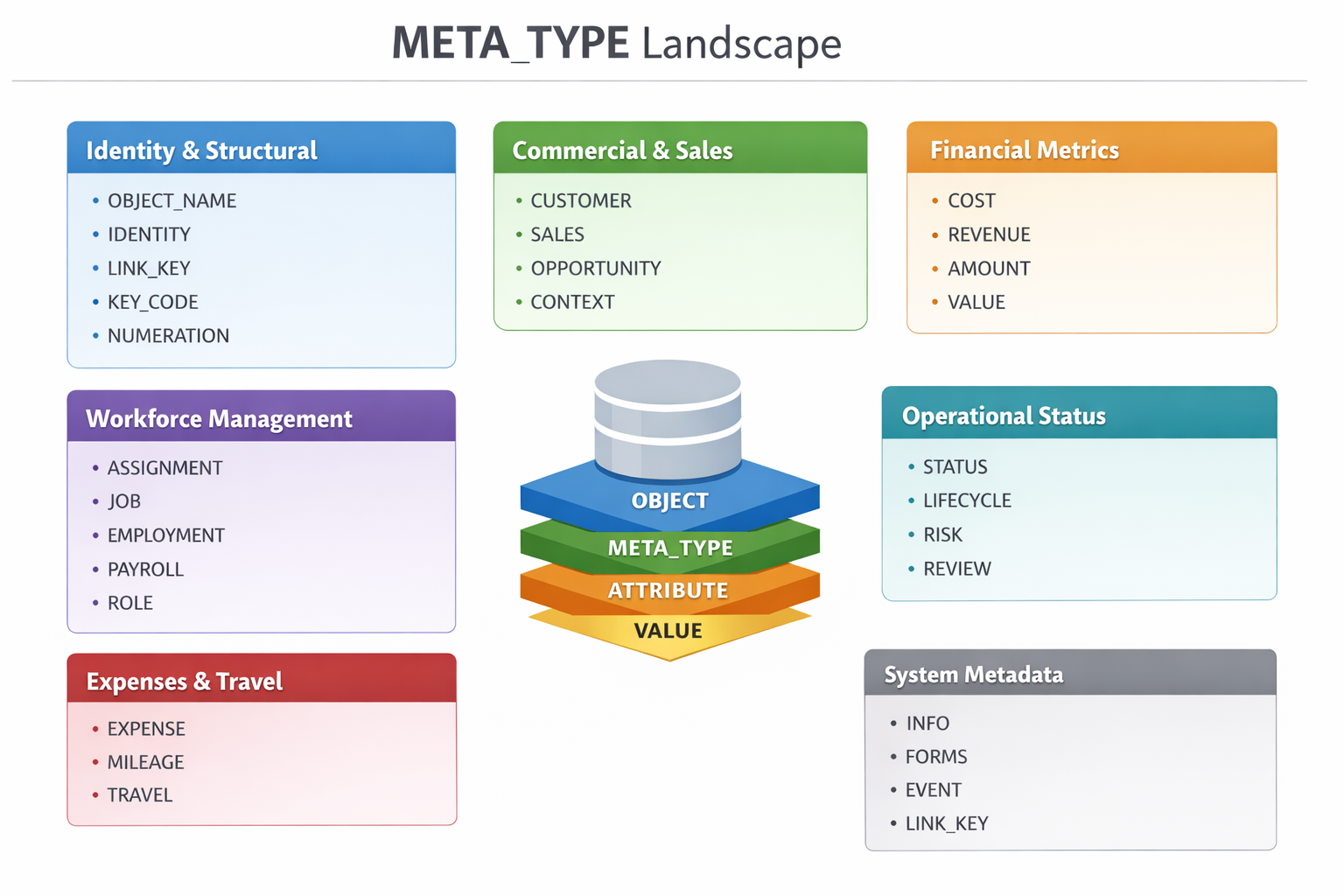
1. Identity Core identifiers and object naming. PurposeObject identifiers. 2. Structural Keys Structural identifiers used to link datasets. PurposeIdentify or reference core business entities. 3. Commercial Context Customer and contractual relationships. PurposeDescribe commercial relationships and contracts. 4. Sales & Pipeline Sales organisation and opportunity tracking. PurposeAnalyse pipeline, opportunity probability, and sales ownership. 5. Financial Values … Read more

Guide to META_TYPES in the CDM Data Views

Purpose META_TYPE is used within CDM metadata views (such as meta_codes, meta_dates, and meta_values) to group related attributes into meaningful analytical categories. Rather than storing hundreds of unrelated attributes, META_TYPE provides a semantic grouping layer that helps analysts understand the nature of the data. Each row therefore follows a pattern similar to: OBJECT β†’ META_TYPE … Read more