
Purpose
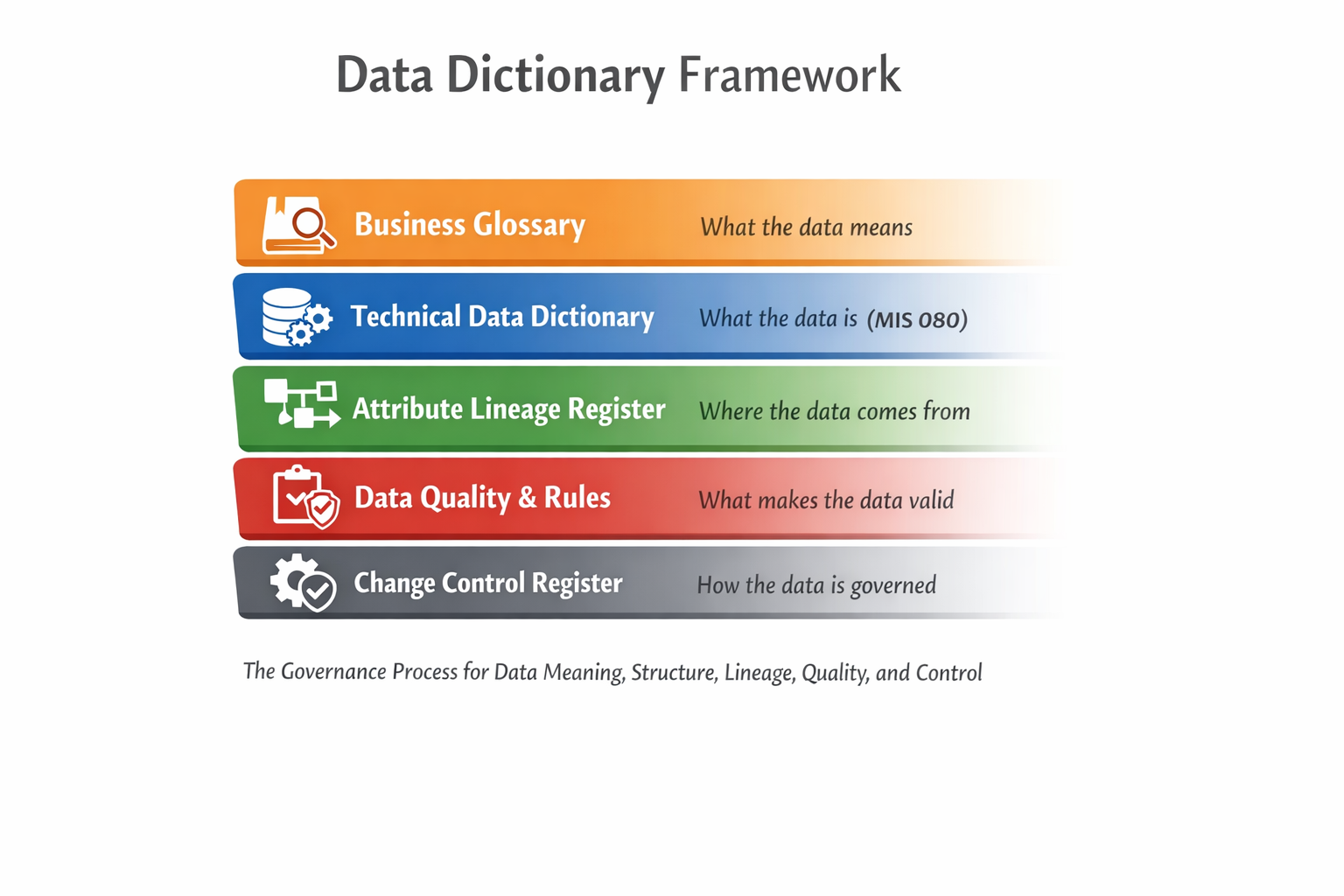
The Data Dictionary is the overarching governance process used to maintain the meaning, structure, lineage, quality rules, and operational control of data assets across the Data Platform.
Rather than existing as a single document or table, the Data Dictionary is delivered through a set of linked artefacts, each addressing a distinct aspect of data knowledge and governance.
This approach ensures that business meaning, technical structure, transformation logic, validation rules, and governance controls remain clear, maintainable, and independently governed.
Core Principle
A simple rule guides the structure of the Data Dictionary framework:
| Question | Artefact |
|---|---|
| What does the data mean? | Business Glossary |
| What is the data structurally? | Technical Data Dictionary |
| Where did the data come from? | Attribute Lineage Register |
| What makes the data valid? | Data Quality & Business Rules Register |
| How is the data governed? | Change Control Register |
Separating these concerns prevents the Data Dictionary from becoming overloaded with unrelated information and supports clearer governance of each aspect.
Data Dictionary Artefacts
1. Business Glossary
Purpose
Defines the business meaning and interpretation of key terms, attributes, and metrics used across reporting and analytics.
Typical contents
- Business term or metric name
- Business definition
- Calculation or interpretation guidance
- Domain ownership and stewardship
- Reporting context and usage notes
Examples
- Order Intake
- Project Start Date
- Net Revenue
- Employee Grade
The glossary focuses on business meaning, not technical implementation.
2. Technical Data Dictionary (MIS 080)
Purpose
Provides the structural definition of data objects and attributes within operational and analytical systems.
Typical contents
- Object or table name
- Attribute or field name
- Data type and format
- Source system
- Target object or view
- Key relationships
- Nullable or mandatory status
- Metadata identifiers used for configuration or workflow management
This artefact explains what the data is structurally.
3. Attribute Lineage Register (CDM Attribute Lineage)
Purpose
Describes how data attributes flow from source systems through transformation processes into the Common Data Model (CDM) and downstream reporting structures.
Typical contents
- Source system and field
- Transformation logic or mapping
- Intermediate objects
- Target attribute or CDM view
- Integration notes or calculation rules
The lineage register answers the question “Where does this data come from?”
Not all lineage attributes require business glossary definitions; some exist purely for technical control or workflow management.
4. Data Quality & Business Rules Register
Purpose
Captures the validation rules and logical constraints that determine whether data is considered valid, complete, and usable.
Typical rule types
- Completeness (mandatory fields)
- Valid ranges or permitted values
- Temporal logic (start and end dates)
- Referential integrity
- Conditional attribute requirements
Examples
- Start date must not be later than end date
- Invoice number must not be null
- Opportunity probability must be between 0 and 100
This artefact documents what makes data acceptable for business use.
5. Change Control Register
Purpose
Provides governance and lifecycle control over data structures, definitions, and transformations.
Typical contents
- Change identifier
- Artefact affected (view, attribute, rule, etc.)
- Description of the change
- Owner or approver
- Release version and date
- Implementation notes
The register ensures that the Data Dictionary framework remains controlled and auditable.
How the Artefacts Work Together
The artefacts collectively support a governed understanding of data across the platform.
Example:
| Artefact | Role |
|---|---|
| Business Glossary | Defines the meaning of “Project Start Date” |
| Technical Dictionary | Identifies the attribute and data type |
| Attribute Lineage | Shows the source field and transformation |
| Quality Rules | Ensures valid date relationships |
| Change Control | Records modifications to the attribute or rule |
Together they form a complete knowledge chain for each data attribute.
Summary
The Data Dictionary is therefore best understood as a governance framework rather than a single register.
By maintaining separate artefacts for meaning, structure, lineage, validation, and governance, the platform achieves:
- clearer data understanding
- stronger data quality controls
- traceable lineage and transformation logic
- structured change management
- scalable documentation as the platform grows